Body is 体 (からだ, karada). Start with 頭 (あたま, atama), head; 顔 (かお, kao), face; 手 (て, te), hand; and 足 (あし, ashi), foot or leg. That last word needs context: Japanese does not always divide the body into the same labels English uses.
Here is a small body map you can name aloud, followed by a test without the labels. The aim is everyday naming, not medical terminology or a list of internal organs.
Start with the face, then name the whole head
Work around the face: 目 (め, me) is an eye, 耳 (みみ, mimi) an ear, 鼻 (はな, hana) the nose, 口 (くち, kuchi) the mouth, and 歯 (は, ha) a tooth. 髪 (かみ, kami) means the hair on your head.
Keep 頭 (あたま, atama), the head, separate from 顔 (かお, kao), the face. If you are labeling a drawing, the eyes, nose and mouth belong on the face; the head is the larger part that includes it.
The Japan Foundation's Erin's Challenge!, Lesson 16, “Body,” gives illustrated labels and readings for these words. The cards here also show their dictionary readings and meanings.
Follow the arm out to the fingers
Move from 首 (くび, kubi), the neck, to 肩 (かた, kata), the shoulder. Then follow 腕 (うで, ude), the arm, down to 手 (て, te), the hand, and 指 (ゆび, yubi), a finger.
For a beginner's body diagram, 腕 (うで, ude) labels the arm and 手 (て, te) labels the hand. Do not swap them just because they are connected. Some expressions use body words more broadly, but these are the basic labels to learn first.
Try drawing an arm with a hand. Put the Japanese names in two different places, then add a finger label. No artistic skill needed.
Name the front, back and lower body
体 (からだ, karada) names the body as a whole. 胸 (むね, mune) is the chest, 背中 (せなか, senaka) the back, and お腹 (おなか, onaka) the belly or stomach area. 膝 (ひざ, hiza) is a knee.
Picture a shirt: the front covers the chest, while the other side covers the back. For the clothes themselves, see clothes in Japanese and the verbs for wearing them.
Does ashi mean foot or leg?
足 (あし, ashi) can mean either. Do not memorize “foot” as its only English meaning.
The National Institute for Japanese Language and Linguistics explains the difference with two examples:
- 足が長い (あしがながい, ashi ga nagai): having long legs. Here the word refers to the legs, not unusually long feet.
- 足が大きい (あしがおおきい, ashi ga ookii): having big feet. Here it refers to the part below the ankle.
長い (ながい, nagai) means “long,” and 大きい (おおきい, ookii) means “big.” These are short descriptions, not two different pronunciations of 足 (あし, ashi). Read the surrounding words and consider what the speaker is describing.
Label a person from memory
Draw a simple person, or imagine one. Close the word cards and answer these prompts aloud:
- Label the whole head, then the face. Give two different words.
- Label the shoulder, arm and hand in that order.
- Label the chest on the front and the back on the other side.
- A character has long legs and big feet. Which body word appears in both Japanese descriptions?
- Add a knee label. What is its reading?
Answer key:
- 頭 (あたま, atama); 顔 (かお, kao).
- 肩 (かた, kata); 腕 (うで, ude); 手 (て, te).
- 胸 (むね, mune); 背中 (せなか, senaka).
- 足 (あし, ashi) in both: 足が長い (あしがながい, ashi ga nagai) and 足が大きい (あしがおおきい, ashi ga ookii).
- 膝 (ひざ, hiza).
Now try the individual words out of order. Say the reading and meaning before flipping each card.
膝Tap to reveal
ひざ hizaknee
顔Tap to reveal
かお kaoface
手Tap to reveal
て tehand
背中Tap to reveal
せなか senakaback (of the body)
歯Tap to reveal
は hatooth
腕Tap to reveal
うで udearm
足Tap to reveal
あし ashifoot, leg
肩Tap to reveal
かた katashoulder
Got it: 0 of 8
Keep one label for your next phone check
Before picking up your phone, name the hand holding it, then the arm attached to that hand. If one word is missing, check it above and try the pair again later. This is a practice suggestion, not a body-recognition feature.
Lock In Japanese offers vocabulary widgets and quizzes before access to apps you choose to seal. The flip cards on this page are separate practice; they do not unlock apps. Our lock-screen learning guide explains that routine.
For your next word group, try JLPT N5 words for everyday situations. This body-parts article is not an N5-only list.
Further reading
- Japan Foundation, Erin's Challenge! I Can Speak Japanese., Lesson 16, Develop vocabulary, “Body”: illustrated head, face, arm and torso vocabulary; the accompanying vocabulary PDF supplies kana readings.
- Japan Foundation, Sydney, Picture Cards: Noun, section O, “Body”: illustrated vocabulary including the knee, hand, arm and leg.
- Wakako Kashino, National Institute for Japanese Language and Linguistics, “暮らしに生きることば:身体をあらわすことば” (“Words in daily life: words for the body”), April 1, 2002: the paragraph contrasting long legs with big feet.
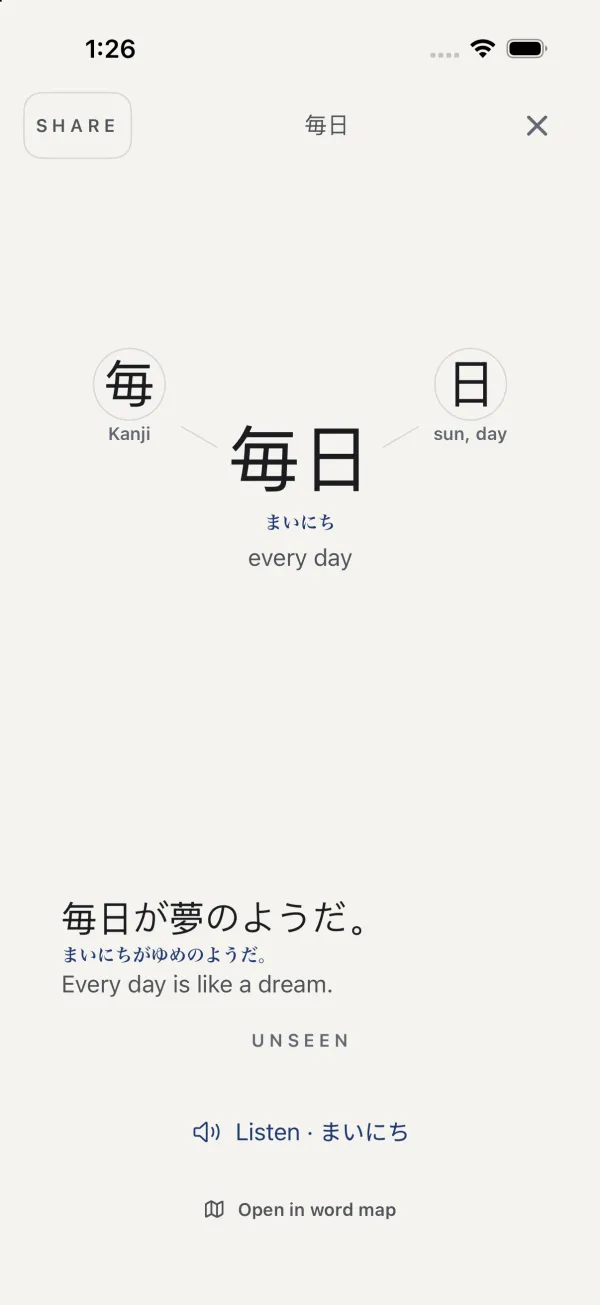
Every word opens like this in Lock In
Kanji, kana and a real sentence, on your lock screen.

Example sentence from Tatoeba, CC BY 2.0 FR.
Word data: JMdict and KANJIDIC2 (EDRDG), CC BY-SA 4.0, adapted.