On Japanese mobile phones, the screen shown while the phone sits idle is called the 待ち受け画面 (まちうけがめん, machiuke gamen), the waiting screen, from 待つ (まつ, matsu), to wait (a usage example on Japanese Wikipedia). Your phone puts it in front of you every time you pick it up, before any app gets a say.
A flashcard app lives somewhere else. It sits behind an icon, and the icon only helps if you tap it. Lock In puts the Japanese word on the waiting screen instead, so the word is there before you decide anything.
Why a flashcards app stays closed
Opening a study app is a decision, and decisions lose to tiredness. You have to remember the app, judge that now is a good moment, and pick it over messages, news and video. After a long day the study app comes last, and often it stays closed.
Japanese has a word for the cost of that decision.
Hand plus interval is 手間 (てま, tema), the time and effort something takes. An app behind an icon has a small 手間 (tema) every time. A word on the waiting screen has none, because you were picking up the phone anyway.
These are the words for the moment you reach for the phone.
- けいたい keitai携帯N3
mobile phone, carrying
- Example一帯いったい ittaithe whole area
- しめる shimeru閉めるN5
to close something
- Example閉まるしまる shimaruto close (by itself)
携帯 (けいたい, keitai) is the mobile phone, and the word also means "carrying". 開ける (あける, akeru) is to open something and 閉める (しめる, shimeru) is to close it.
The lock screen word you see without trying
Japanese splits seeing into two verbs, and the split explains how a lock screen works.
見る (みる, miru) is to look at something on purpose. 見える (みえる, mieru) is for something to come into view, whether or not you meant to look. Sound has the same pair: 聞く (きく, kiku) is to listen, and 聞こえる (きこえる, kikoeru) is to be audible.
A flashcard app needs 見る (miru). You choose to open it and look. A word on the lock screen is 見える (mieru). It is in view when you check the time, when a message comes in, when you pick up the phone at a red light.
Seeing a word that often makes it familiar. Producing the word from memory, with nothing on the screen to help, is a second skill, and it needs its own step.
Spacing without a calendar
Forgetting has a measured shape. Hermann Ebbinghaus memorised nonsense syllables, then tested how many he still had hours and days later, and published the results in 1885. His forgetting curve falls fastest soon after learning and then levels off. Reviews spread across days hold up better than the same reviews crammed into one sitting, which psychologists call the spacing effect.
Flashcard apps handle spacing with a schedule you have to keep. The waiting screen keeps it for you, because you come back to it all day. 学ぶ (まなぶ, manabu), to learn, might be on it at breakfast and again at lunch, and in the evening it is the word you recall before the seal on your social apps lifts.
Now plus evening is tonight, 今晩 (こんばん, konban). It is also the start of the greeting こんばんは (konbanwa), good evening. The final は (ha) is the topic particle, which is pronounced wa.
Japanese gives you separate verbs for the stages of a word in your head.
- おぼえる oboeru覚えるN5
to memorize, to remember
- Example覚ますさます samasuto wake someone, to sober up
- ふくしゅう fukushuu復習N4
review (of lessons)
- Example習うならう narauto learn from someone
分かる (わかる, wakaru) is to understand. You see the word and it makes sense. 覚える (おぼえる, oboeru) is to memorise, and also to remember: you can bring the word back yourself. 忘れる (わすれる, wasureru) is what happens when you do neither for too long. 復習 (ふくしゅう, fukushuu), review, is how a word moves from 分かる (wakaru) to 覚える (oboeru).
見るTap to reveal
みる miruto see, to watch
見えるTap to reveal
みえる mieruto be visible
聞こえるTap to reveal
きこえる kikoeruto be audible
覚えるTap to reveal
おぼえる oboeruto memorize, to remember
忘れるTap to reveal
わすれる wasureruto forget
分かるTap to reveal
わかる wakaruto understand
今晩Tap to reveal
こんばん konbantonight
手間Tap to reveal
てま tematime and effort
Got it: 0 of 8
Ten seconds instead of a study hour
時間 (じかん, jikan) means time, and also hours. Lock In asks for very little of it. The unit is the few seconds you spend unlocking, repeated across the day.
One plus day is 一日 (いちにち, ichinichi), one whole day. Spread across a whole day, those few seconds add up to many short meetings with the same word, and none of them needed a plan.
Where to start with lock screen learning
Begin with JLPT N5 in your pocket for the beginner routine, then pick five words from our JLPT N5 words list. Keep them until they come back easily. If you are comparing tools first, our Japanese flashcards app guide lists what to test before paying.
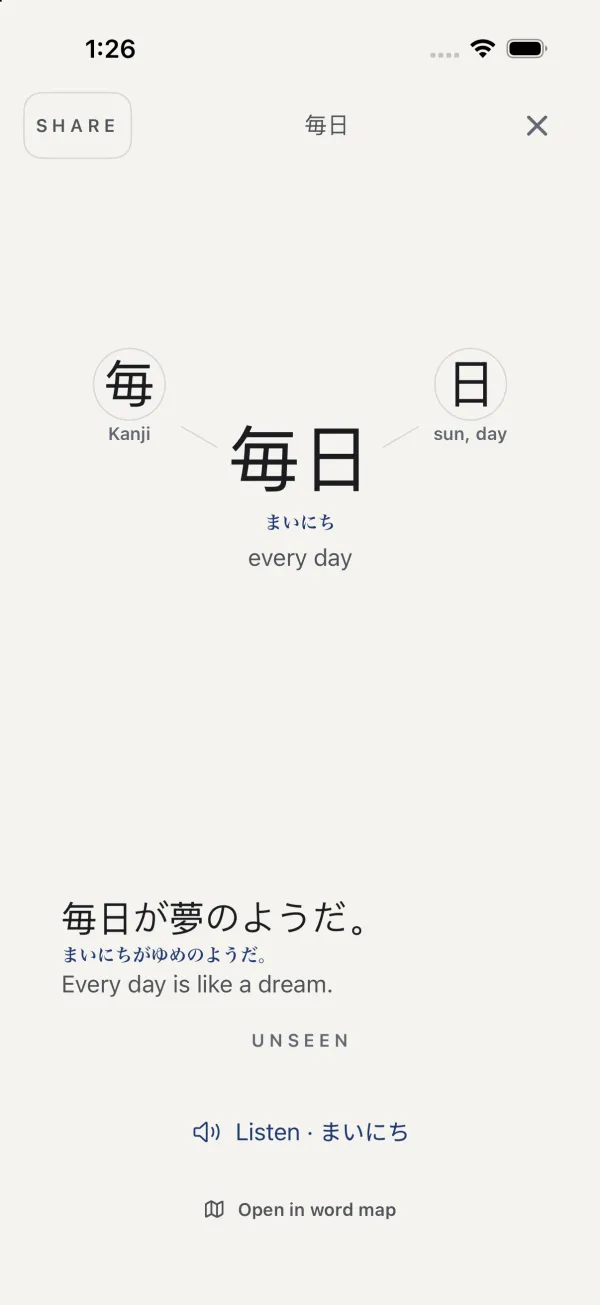
Every word opens like this in Lock In
Kanji, kana and a real sentence, on your lock screen.

Example sentence from Tatoeba, CC BY 2.0 FR.
Word data: JMdict and KANJIDIC2 (EDRDG), CC BY-SA 4.0, adapted.