Monday is 月曜日 (げつようび, getsuyoubi). Tuesday is 火曜日 (かようび, kayoubi). The ending stays the same all week: 曜日 (ようび, youbi), “day of the week.” Learn the seven beginnings and you can read the weekday labels on a Japanese calendar.
Start with the full words. Then try the calendar exercise below without counting forward from Monday.
The seven days, with readings
- げつようび getsuyoubi月曜日N5
Monday
- Example明後日あさって asattethe day after tomorrow
- すいようび suiyoubi水曜日N5
Wednesday
- Example明後日あさって asattethe day after tomorrow
- もくようび mokuyoubi木曜日N5
Thursday
- Example明後日あさって asattethe day after tomorrow
- にちようび nichiyoubi日曜日N5
Sunday
- Example明後日あさって asattethe day after tomorrow
The first characters give you pictures to remember: 月 is moon, 火 fire, 水 water, 木 wood, 金 gold or metal, 土 earth, and 日 sun. Use those meanings as memory aids, not instructions to use each character's standalone reading.
For example, water on its own is 水 (みず, mizu), but Wednesday is 水曜日 (すいようび, suiyoubi). Do not attach the ending to mizu. The word needs sui.
The Japan Foundation's Irodori gives kana readings for all seven weekdays. Tokyo University of Foreign Studies explains the long-vowel spelling in its pronunciation section 2.2.1 and the separate beat for the nasal sound in section 2.4.1.
Read the calendar labels, not their positions
Calendars often shorten a weekday to its first kanji. In that setting, 水 labels Wednesday, not a supply of water. The Japan Foundation's Irodori Starter, Lesson 9, uses these single-kanji labels in its scheduling exercises. Check the headings rather than guessing from a column's position.
Here is a practice schedule. These are invented appointments, not a real business's opening hours.
| Calendar label | Your plan |
|---|---|
| 火 | Library visit |
| 木 | Japanese lesson |
| 日 | Lunch with a friend |
Before looking back at the cards:
- Which weekday is the Japanese lesson? Say the full Japanese word.
- Which weekday is lunch?
- Your library visit moves from 火 to 金. Say the old day and the new day.
Answers: The lesson is 木曜日 (もくようび, mokuyoubi), Thursday. Lunch is 日曜日 (にちようび, nichiyoubi), Sunday. The library visit moves from 火曜日 (かようび, kayoubi), Tuesday, to 金曜日 (きんようび, kin'youbi), Friday.
Notice Sunday: 日 appears twice in 日曜日, but the first is read nichi and the last bi. Learn the complete word rather than assigning one sound to every 日.
Ask which weekday, not which date
To ask today's weekday, say 今日は何曜日ですか。 (きょうはなんようびですか, kyou wa nan'youbi desu ka). A possible answer is 今日は木曜日です。 (きょうはもくようびです, kyou wa mokuyoubi desu): “Today is Thursday.” This is a practice answer, not a live date display.
The key word is 何曜日 (なんようび, nan'youbi), “what day of the week.” Compare 今日は何日ですか。 (きょうはなんにちですか, kyou wa nannichi desu ka): that asks today's date within the month. The weekday question wants an answer such as Thursday, not the fifteenth.
To suggest a convenient day, use 火曜日がいいです。 (かようびがいいです, kayoubi ga ii desu), “Tuesday works for me.” Swap in another weekday before が (ga) to change your answer. This scheduling pattern is taught in Irodori Starter, Lesson 9, grammar note 3.
Recall the days out of order
Now test the whole set. Say each reading and meaning before revealing the answer. Mark a card “again” if either part is missing.
木曜日Tap to reveal
もくようび mokuyoubiThursday
日曜日Tap to reveal
にちようび nichiyoubiSunday
火曜日Tap to reveal
かようび kayoubiTuesday
金曜日Tap to reveal
きんようび kin'youbiFriday
月曜日Tap to reveal
げつようび getsuyoubiMonday
土曜日Tap to reveal
どようび doyoubiSaturday
水曜日Tap to reveal
すいようび suiyoubiWednesday
Got it: 0 of 7
For your next phone check, try one extra question before looking at the date: can you say today's weekday in Japanese? Check the calendar afterward. If you missed it, return to that word here rather than reciting the entire week.
Lock In Japanese offers vocabulary widgets on the Lock Screen and quizzes before apps you choose to seal. Those are different activities: a visible answer is a chance to look; an answer you produce without help is a recall attempt. Our lock-screen learning guide explains the routine.
For more beginner words, continue with JLPT N5 words grouped for daily use. If kana is still new, JLPT N5 in your pocket introduces the scripts alongside vocabulary.
Further reading
- Japan Foundation, Irodori: Japanese for Life in Japan, Starter, Lesson 9, pages 8–11 and grammar note 3: weekday readings, abbreviated labels and arranging a day.
- Tokyo University of Foreign Studies, Japanese pronunciation modules, sections 2.2.1 and 2.4.1: long vowels and the nasal sound before a vowel or semivowel.
- Shogakukan, Digital Daijisen, entry for 何日 (なんにち, nannichi), available on Kotobank: the date-within-a-month sense, distinct from the number-of-days sense.
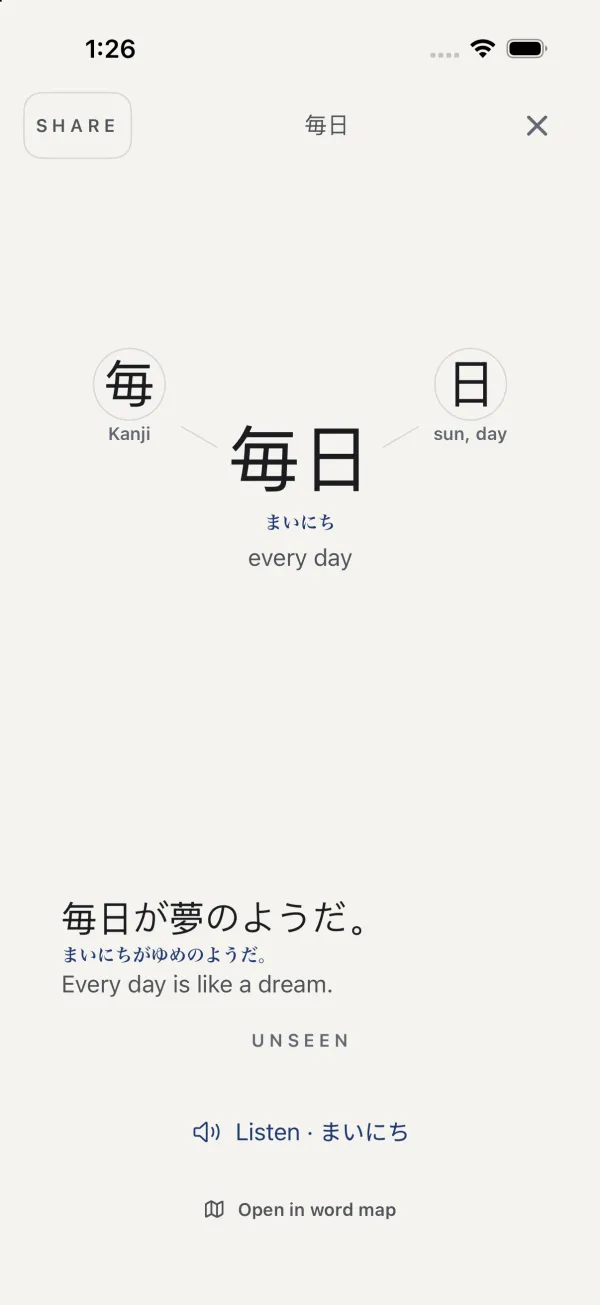
Every word opens like this in Lock In
Kanji, kana and a real sentence, on your lock screen.

Example sentence from Tatoeba, CC BY 2.0 FR.
Word data: JMdict and KANJIDIC2 (EDRDG), CC BY-SA 4.0, adapted.