To describe today's weather in Japanese, start with 晴れ (はれ, hare), clear weather; 曇り (くもり, kumori), cloudy weather; 雨 (あめ, ame), rain; and 雪 (ゆき, yuki), snow. For temperature, use 暑い (あつい, atsui), hot, or 寒い (さむい, samui), cold. 今日は晴れです。 (きょうははれです, kyou wa hare desu) means “It is clear today.” 今日は寒いです。 (きょうはさむいです, kyou wa samui desu) means “It is cold today.” Both can describe the same day.
Your task here is one short weather report: say what the sky is doing, then how the air feels. Forecast probabilities and storm terminology can wait.
Name what you see
天気 (てんき, tenki) means “weather,” and 風 (かぜ, kaze) means “wind.” The Japan Foundation's Irodori Elementary 1, Lesson 4, introduces these weather words alongside the verbs used with them.
For a simple description, put です (desu) after a weather noun:
- 晴れです。 (はれです, hare desu): It is clear.
- 曇りです。 (くもりです, kumori desu): It is cloudy.
- 雨です。 (あめです, ame desu): It is rainy.
- 雪です。 (ゆきです, yuki desu): It is snowy.
Add 今日 (きょう, kyou), “today,” and the topic marker は (wa) to specify the day. Pronounce that particle wa, even though its kana is は (ha). The Japan Foundation's Marugoto Plus, A2 Lesson 4 grammar notes, shows this noun-and-です (desu) sentence structure.
Say that rain is falling now
English “rain” can name the weather or act as a verb. In Japanese, pair the noun with 降る (ふる, furu), “to fall,” for rain or snow. Wind uses 吹く (ふく, fuku), “to blow.”
- ふる furu降るN5
to fall (rain, snow)
- Example降りるおりる oriruto get off, to go down
These are the dictionary forms. To report what is happening outside now, learn these complete phrases:
- 雨が降っています。 (あめがふっています, ame ga futte imasu): It is raining.
- 雪が降っています。 (ゆきがふっています, yuki ga futte imasu): It is snowing.
- 風が吹いています。 (かぜがふいています, kaze ga fuite imasu): The wind is blowing.
Notice the different middles: 降って (ふって, futte) but 吹いて (ふいて, fuite). Each is a verb's te-form, followed here by います (imasu). Irodori Lesson 4, grammar note 3, teaches this pattern for current weather; Marugoto Plus gives rain and snow examples too.
You can say 晴れています (はれています, harete imasu), “It is clear,” or 曇っています (くもっています, kumotte imasu), “It is cloudy,” as well. The noun sentences above are not your only option.
Describe the air, not your drink
The four temperature words are 暑い (あつい, atsui), hot; 暖かい (あたたかい, atatakai), warm; 涼しい (すずしい, suzushii), cool; and 寒い (さむい, samui), cold. Irodori Lesson 3 introduces all four. Keep the final i when adding です (desu): 涼しいです。 (すずしいです, suzushii desu), “It is cool.”
A clear sky does not tell you which temperature word to choose. Practise making two separate observations: 晴れです。寒いです。 (はれです。さむいです, hare desu. Samui desu), “It is clear. It is cold.”
For a hot drink, use a different kanji: 熱い (あつい, atsui). The pronunciation is the same as 暑い (あつい, atsui), but the heat belongs to the drink, not the weather. The Agency for Cultural Affairs' guidance on same-reading kanji distinguishes these uses.
For cold water, use 冷たい (つめたい, tsumetai), “cold to the touch,” rather than 寒い (さむい, samui). These meanings are also distinguished in JMdict.
- つめたい tsumetai冷たいN5
cold (to the touch)
- Example冷蔵庫れいぞうこ reizoukorefrigerator
Give three imaginary windows a weather report
These are practice scenes, not live weather observations. Try answering before reading the key.
- Window A: a clear sky, but the air feels cold. Give two short sentences.
- Window B: snow is falling right now. Give the full verb sentence.
- Window C: wind is blowing and the air feels warm. Describe both.
- Inside, your tea is hot. Which written word fits: 暑い or 熱い, both read あつい (atsui)?
Answer key:
- 晴れです。寒いです。 (はれです。さむいです, hare desu. Samui desu): It is clear. It is cold.
- 雪が降っています。 (ゆきがふっています, yuki ga futte imasu): It is snowing.
- 風が吹いています。暖かいです。 (かぜがふいています。あたたかいです, kaze ga fuite imasu. Atatakai desu): The wind is blowing. It is warm.
- 熱い (あつい, atsui), the word for the drink's heat.
Now test the words without the scenes. Say the reading and meaning before revealing each card.
曇りTap to reveal
くもり kumoricloudy weather
暖かいTap to reveal
あたたかい atatakaiwarm (weather)
雨Tap to reveal
あめ amerain
寒いTap to reveal
さむい samuicold (weather)
吹くTap to reveal
ふく fukuto blow (wind)
晴れTap to reveal
はれ hareclear weather
降るTap to reveal
ふる furuto fall (rain, snow)
涼しいTap to reveal
すずしい suzushiicool (weather)
Got it: 0 of 8
Try your own window next
Before your next phone check, look outside and give your two-sentence report without this page. If a word is missing, check its card and try again later. This is a practice suggestion, not a weather-aware app feature.
Lock In Japanese offers vocabulary widgets and quizzes before access to apps you choose to seal. Our lock-screen learning guide explains that routine. This page's flip cards are separate practice, not the quiz that unlocks an app.
For other everyday word groups, use JLPT N5 words grouped for daily use. To describe the umbrella you take out on a rainy day, try colors in Japanese.
Further reading
- Japan Foundation, Irodori: Japanese for Life in Japan, Elementary 1, Lesson 3, vocabulary preparation: temperature words and their readings; Lesson 4, vocabulary preparation and grammar note 3: weather nouns, verb pairings and current-weather expressions.
- Japan Foundation, Marugoto Plus, A2 Topic 2, Lesson 4, grammar notes 1 and 2: noun and adjective sentence endings, and ongoing rain and snow.
- Agency for Cultural Affairs, Examples of the Use of Different Kanji with the Same Kun Reading, report of February 21, 2014, entry 008: distinguishing 暑い (あつい, atsui) from 熱い (あつい, atsui).
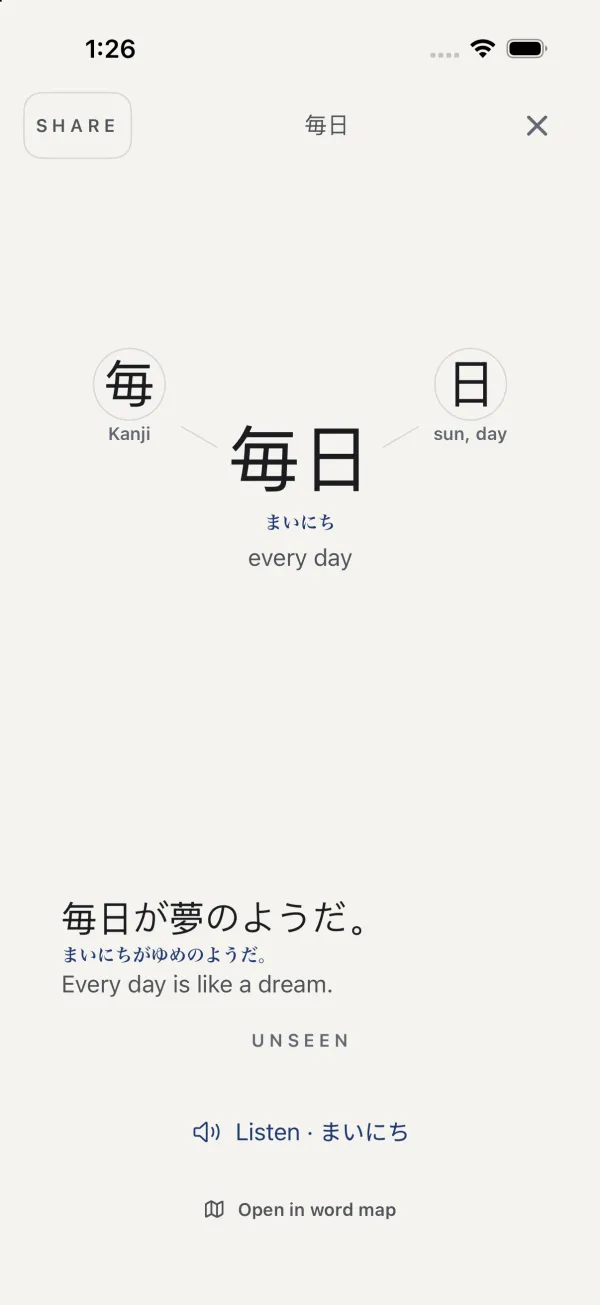
Every word opens like this in Lock In
Kanji, kana and a real sentence, on your lock screen.

Example sentence from Tatoeba, CC BY 2.0 FR.
Word data: JMdict and KANJIDIC2 (EDRDG), CC BY-SA 4.0, adapted.