Left is 左 (ひだり, hidari), right is 右 (みぎ, migi), and straight ahead is まっすぐ (massugu). To ask where the station is, say すみません。駅はどこですか。 (すみません。えきはどこですか, sumimasen. Eki wa doko desu ka): “Excuse me. Where is the station?”
The question gets the conversation started. Your next job is to catch the reply: which way to go, where to turn, and which side to look on. Start with those words before adding the compass points.
Three words for the next junction
- まがる magaru曲がるN5
to turn (a corner)
- Example作曲さっきょく sakkyokumusical composition
曲がる (まがる, magaru) means “to turn,” and 行く (いく, iku) means “to go.” In a polite instruction, you will hear different endings:
- 左に曲がってください。 (ひだりにまがってください, hidari ni magatte kudasai): Please turn left.
- 右に曲がってください。 (みぎにまがってください, migi ni magatte kudasai): Please turn right.
- まっすぐ行ってください。 (まっすぐいってください, massugu itte kudasai): Please go straight.
The request uses a verb's te-form followed by ください (kudasai). Here the forms are 曲がって (まがって, magatte) and 行って (いって, itte). Keep them as complete phrases for now. NHK WORLD-JAPAN's Easy Japanese, Lessons 7 and 32, explains this request pattern and uses it for directions.
Ask for a location, or ask for the route
NHK's Lesson 1 teaches place + はどこですか (wa doko desu ka), “Where is [place]?” The は (wa) marks the topic here; pronounce it wa, not ha.
For the route rather than just the location, use:
駅まで、どう行ったらいいですか。 (えきまで、どういったらいいですか, eki made, dou ittara ii desu ka): “How can I get to the station?”
This follows the destination question in NHK's Lesson 32. Put the destination before まで (made), and keep the rest of the question together.
If the reply comes too fast, use ゆっくり話してください。 (ゆっくりはなしてください, yukkuri hanashite kudasai), “Please speak slowly.” If you missed a step, try もう一度言ってください。 (もういちどいってください, mou ichido itte kudasai), “Please say it again.” Both are taught in Lesson 7.
Finish with ありがとうございます。 (arigatou gozaimasu), “Thank you.”
Hear the landmark and the side separately
A short reply may tell you both where to turn and where the destination sits. These words help you separate the two.
For a street corner, 角 is read かど (kado). In this route phrase, the corner comes before を (o), and the turning direction comes before に (ni):
角を右に曲がってください。 (かどをみぎにまがってください, kado o migi ni magatte kudasai): “Please turn right at the corner.”
Compare that instruction with 駅は左にあります。 (えきはひだりにあります, eki wa hidari ni arimasu): “The station is on the left.” The second sentence tells you where the station is. It does not tell you to make another left turn.
For a position relative to the station, use 駅の前 (えきのまえ, eki no mae), “in front of the station”; 駅の後ろ (えきのうしろ, eki no ushiro), “behind the station”; or 駅の隣 (えきのとなり, eki no tonari), “next to the station.” The の (no) connects the landmark to the position word.
JapanesePod101's “Giving and Asking for Directions” gives the corner-turn pattern and examples of locations beside and behind landmarks. NHK's Lesson 32 contrasts going straight with finding a building on the left.
Compass directions do not turn with you
The four compass points are 北 (きた, kita), north; 東 (ひがし, higashi), east; 南 (みなみ, minami), south; and 西 (にし, nishi), west. JapanesePod101's compass vocabulary gives these readings and meanings.
Follow the reply without looking back
Imagine a straight road heading north toward a corner. You are standing on that road, facing north. This is a practice scene, not directions to a real station.
Read these instructions once:
- まっすぐ行ってください。 (まっすぐいってください, massugu itte kudasai)
- 角を右に曲がってください。 (かどをみぎにまがってください, kado o migi ni magatte kudasai)
- 駅は左にあります。 (えきはひだりにあります, eki wa hidari ni arimasu)
Look away. Which way do you turn at the corner? Which compass direction are you walking afterward? On which side of the road is the station?
Answers: Turn right. You are now walking east, 東 (ひがし, higashi). The station is on your left, the north side of the road in this scene. The last sentence describes its position, not a second turn.
Now change only the second instruction to 角を左に曲がってください。 (かどをひだりにまがってください, kado o hidari ni magatte kudasai). You would walk west, 西 (にし, nishi), after the corner. With the station still on your left, it would now be on the south side of the road.
Test the individual words out of order too. Say the reading and meaning before revealing each card.
右Tap to reveal
みぎ migiright side
北Tap to reveal
きた kitanorth
曲がるTap to reveal
まがる magaruto turn (a corner)
西Tap to reveal
にし nishiwest
左Tap to reveal
ひだり hidarileft side
まっすぐTap to reveal
まっすぐ massugustraight ahead
南Tap to reveal
みなみ minamisouth
東Tap to reveal
ひがし higashieast
Got it: 0 of 8
Keep one small recall task for later
Before your next phone check, while standing somewhere safe, point left and right and name each in Japanese. Then say “please turn right” without looking here. This is a practice suggestion, not an automatic route exercise in the app.
Lock In Japanese offers vocabulary widgets and quizzes before access to apps you choose to seal. Our lock-screen learning guide explains that routine. The quiz on this page is separate: it tests words, not navigation, and does not unlock your apps.
For more place words, use JLPT N5 words grouped for daily use. If you need help reading the kana beside the kanji, start with the script introduction in JLPT N5 in your pocket.
Further reading
- NHK WORLD-JAPAN, Easy Japanese, Lesson 1, “Where is Haru-san House?”: asking where a place is, the topic particle, and thanking someone.
- NHK WORLD-JAPAN, Easy Japanese, Lesson 7, “Please speak slowly.”: polite requests, te-forms, and asking for repetition.
- NHK WORLD-JAPAN, Easy Japanese, Lesson 32, “How can I get to the Ninja Museum?”: asking for a route, going straight, and locating a building on the left.
- JapanesePod101, “Giving and Asking for Directions: ‘Right’ in Japanese & More”: compass readings, corner turns and positions relative to landmarks.
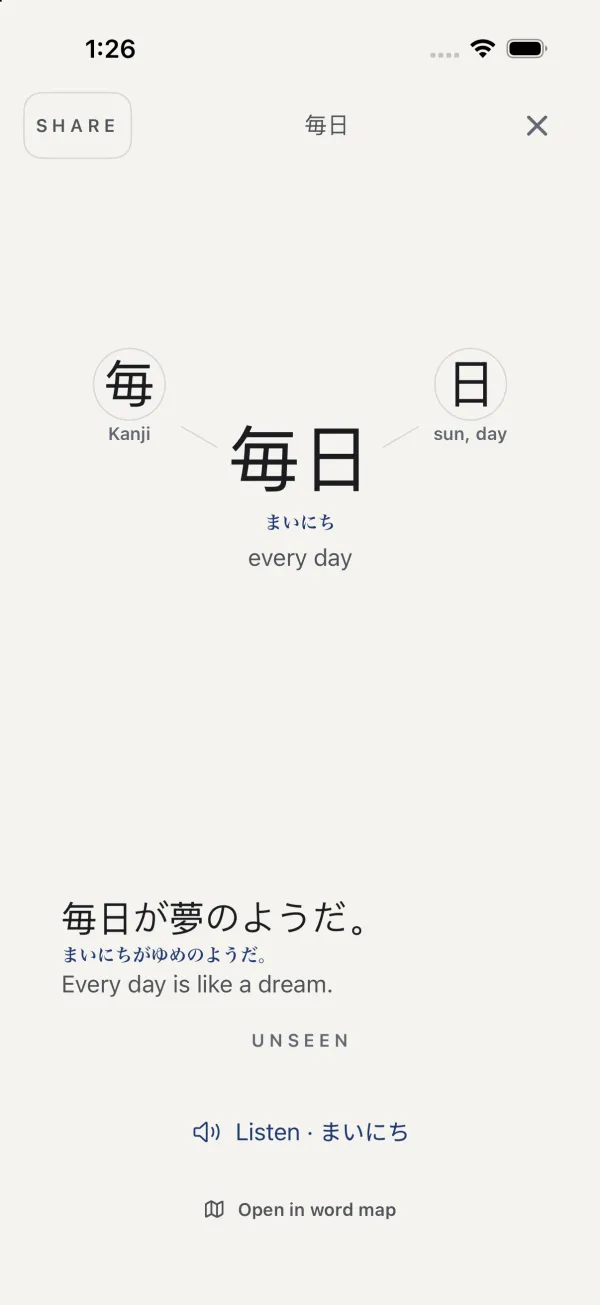
Every word opens like this in Lock In
Kanji, kana and a real sentence, on your lock screen.

Example sentence from Tatoeba, CC BY 2.0 FR.
Word data: JMdict and KANJIDIC2 (EDRDG), CC BY-SA 4.0, adapted.