JLPT N5 is the first rung of the Japanese proficiency ladder. One of its words is ポケット (poketto), pocket. Japanese borrowed the English word and wrote it in katakana.
The test organisers describe N5 as reading "typical expressions and sentences written in hiragana, katakana, and basic kanji", and following short, slow conversations about daily life (JLPT level summary). That is enough to read a menu, introduce yourself and find the exit at a station.
What N5 really asks for
N5 starts with the scripts. Japanese uses three at once, and each has a name you can learn as a word.
漢字 (かんじ, kanji) are the characters Japan took from Chinese. 平仮名 (ひらがな, hiragana) is the rounded script for grammar and native words. 片仮名 (かたかな, katakana) is the angular one for borrowed words like ポケット (poketto). The 片 in katakana means partial, because its letters started as fragments of kanji, written by Buddhist monks in the 9th century as a kind of shorthand (katakana on Wikipedia).
The kana come first for a practical reason. A good share of N5 words have no kanji at all, so kana alone lets you sound them out before you learn a single kanji (the counts).
Then come the everyday words that the rest is built from.
Those six already make sentences. 私は学生です (わたしはがくせいです, watashi wa gakusei desu) is "I am a student". これは水です (これはみずです, kore wa mizu desu) is "this is water". Add 行く (いく, iku, to go) and 食べる (たべる, taberu, to eat) and you can talk about where you are going and what you are eating.
One word at a glance
Instead of a lesson, N5 arrives as a slow drip. Each day one word sits on your lock screen with its reading and meaning. 読む (よむ, yomu), to read. You see it at breakfast, on the train, while you wait for coffee. By evening it is familiar.
日 (ひ, hi), sun or day, is a good kanji to meet that way, because it keeps coming back. Our JLPT N5 words list counts how often.
- いちにち ichinichi一日N5
one whole day
- Example明後日あさって asattethe day after tomorrow
- たんじょうび tanjoubi誕生日N5
birthday
- Example明後日あさって asattethe day after tomorrow
- にちようび nichiyoubi日曜日N5
Sunday
- Example明後日あさって asattethe day after tomorrow
Read the grid as a calendar. 今日 (きょう, kyou) is today. 毎日 (まいにち, mainichi) is every day. 誕生日 (たんじょうび, tanjoubi) is your birthday. 日曜日 (にちようび, nichiyoubi) is Sunday, the sun's day of the week.
Bright, after and day make the day after tomorrow, 明後日 (あさって, asatte). The reading has nothing to do with the parts. You learn it as one sound, the way you learned "tomorrow" as one word in English.
From reading to recall
Recognition comes first, then recall. A glance tells you the shape is familiar. Recall asks you to produce the word with nothing to lean on. After a word has ridden your lock screen for a few days, the quiz flips it: you see the meaning and reach for the word. That flip is where a word moves from something you have seen to something you know.
Try the flip now on the words above.
漢字Tap to reveal
かんじ kanjikanji
平仮名Tap to reveal
ひらがな hiraganahiragana
片仮名Tap to reveal
かたかな katakanakatakana
今日Tap to reveal
きょう kyoutoday
明日Tap to reveal
あした ashitatomorrow
毎日Tap to reveal
まいにち mainichievery day
学生Tap to reveal
がくせい gakuseistudent
水Tap to reveal
みず mizuwater
Got it: 0 of 8
If 今日 and 明日 trip you up, that is useful. They share 日, so you have to read the first character instead of guessing from the shape of the whole word.
A pocket-sized finish line
Begin with five words and return to them before adding more. There is no study block and no streak to protect. The words go where you were going to look anyway.
The phrase you will use most on a busy day is a bit, a moment, "a bit" or "a moment". ちょっと待って (ちょっとまって, chotto matte) means "wait a moment". It also describes the routine: one moment, then back to your day.
Choose your next words
Use our JLPT N5 words list to choose a small group with readings and English meanings. For the daily rhythm, read how lock-screen learning works. Before choosing a paid tool, use our Japanese flashcards app guide to check review, audio and purchase terms.
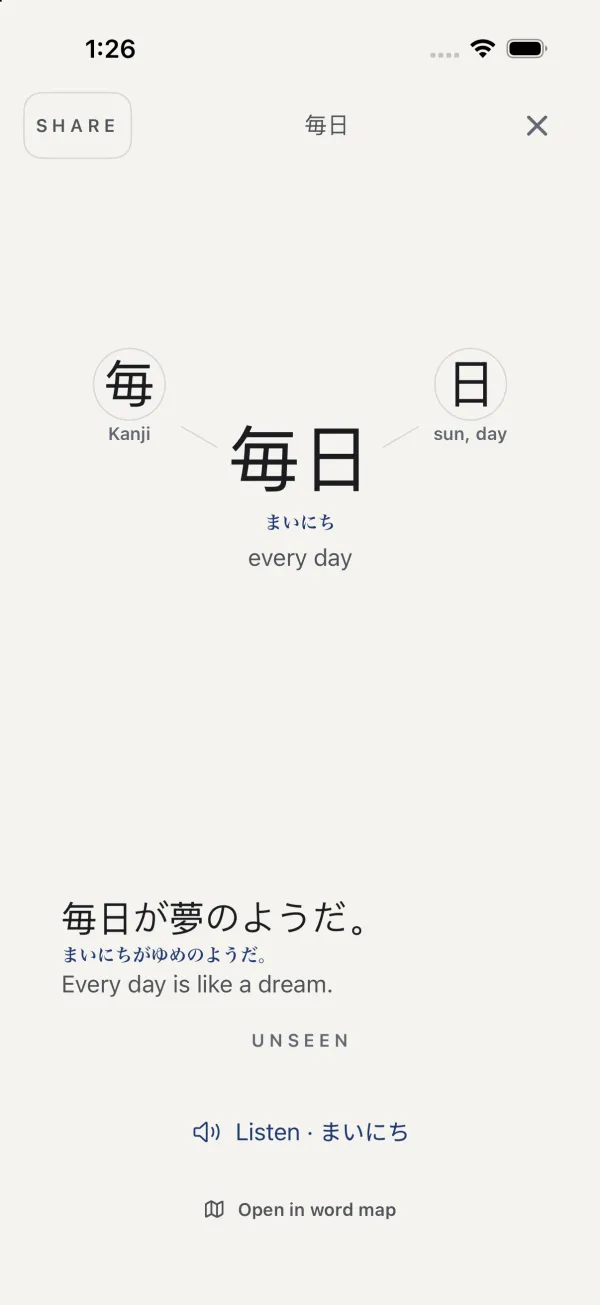
Every word opens like this in Lock In
Kanji, kana and a real sentence, on your lock screen.

Example sentence from Tatoeba, CC BY 2.0 FR.
Word data: JMdict and KANJIDIC2 (EDRDG), CC BY-SA 4.0, adapted.